Lost in the Markets and Moments of Papeete
Papeete, Tahiti—the name alone sparks visions of turquoise waters and palm trees, but the real magic? It’s in the rhythm of daily life, where slow travel reveals the heart of the city. Forget rushing through checklists. Here, it’s about lingering over coffee in a waterfront market, chatting with local vendors, and letting the urban pulse guide you. This is not just sightseeing—it’s *feeling* a place. Beyond the postcard-perfect beaches and overwater bungalows lies a capital humming with authenticity, color, and quiet grace. Papeete invites travelers to step off the plane not as tourists, but as temporary locals, ready to absorb the cadence of island life. The true richness of Tahiti unfolds not only in its natural beauty but in the warmth of its markets, the charm of its streets, and the unhurried exchanges between neighbors and visitors alike.
Arrival in Papeete: First Impressions Beyond the Postcard
Stepping off the plane at Faa’a International Airport, travelers are immediately wrapped in the soft warmth of Tahiti’s tropical climate. The air carries a faint scent of frangipani and sea salt, a subtle hint of what lies ahead. Just a short fifteen-minute drive from the airport, Papeete begins to reveal itself—not as a sprawling metropolis, but as a compact, vibrant capital where urban energy meets island ease. Unlike the secluded resorts that dot the coastline, Papeete pulses with everyday life. Women in floral muumuus walk home from church, children wave from school buses, and fishermen unload their morning catch along the waterfront.
This contrast is precisely what makes Papeete so compelling. Many visitors arrive expecting silence and seclusion, only to find a city alive with conversation, music, and movement. Yet, there’s no jarring dissonance—Papeete maintains a calm that permeates even its busiest moments. Traffic moves slowly, voices rarely rise, and smiles are exchanged freely. The journey from airport to town, winding past lush hills and glimpses of the Pacific, offers the first lesson in island time: things happen when they happen. Rushing is not only unnecessary—it’s out of place.
For those committed to slow travel, this initial transition is vital. Rather than hurrying to a distant resort, consider beginning your stay in the heart of the city. Local guesthouses and boutique accommodations offer intimate access to Papeete’s rhythms. Waking to the sound of church bells, stepping out onto a shaded veranda with a view of the marina—these quiet moments set the tone for a deeper experience. Arrival, in Papeete, should not be a passage through, but an immersion in.
The Pulse of Place: Why Slow Travel Fits Papeete Perfectly
At its core, slow travel is about presence—about being fully engaged with a place rather than simply passing through it. In Papeete, this philosophy finds its natural home. The Tahitian concept of *tama’ara’a*, meaning daily life or ordinary existence, is not something to escape, but to embrace. Life here unfolds at a pace that allows space for connection, reflection, and spontaneity. There is no pressure to maximize every hour; instead, value is placed on quality of experience, not quantity of sights seen.
This mindset aligns perfectly with the local culture, where *maururu*—thank you—is more than a word. It’s a gesture of gratitude, a recognition of shared humanity. In markets, shops, and cafés, interactions are rarely transactional. A simple purchase becomes an exchange of smiles, stories, and sometimes, an invitation to taste something new. This warmth is not performative; it’s woven into the fabric of daily life.
Commercial spaces in Papeete are not just places to buy goods—they are social hubs. The morning market bustles not only with shoppers but with neighbors catching up, children sampling fruit, and elders offering quiet blessings. An afternoon stroll down Boulevard Pomare reveals more than storefronts; it reveals lives unfolding in real time. A tailor adjusts a dress by hand, a musician tunes a ukulele outside a café, a vendor arranges a bouquet of red tiare flowers. These moments are not curated for tourists; they are simply life as it is lived.
When travelers slow down, they begin to feel this rhythm. They notice the way light filters through palm fronds onto cobblestone paths, how laughter carries across open-air markets, how time seems to stretch and soften. This is not laziness—it is intentionality. In Papeete, moving slowly is not a luxury; it is the key to understanding.
Le Marché de Papeete: More Than a Market—A Living Community Space
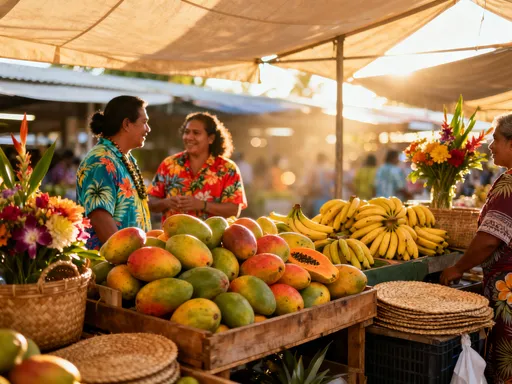
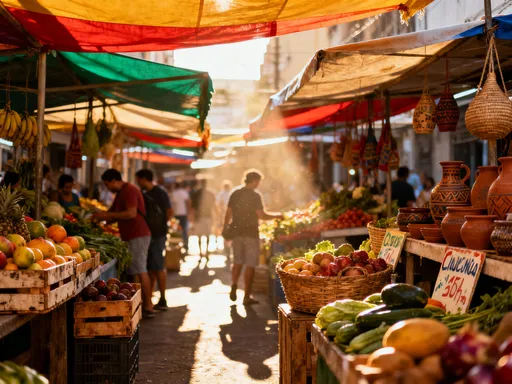
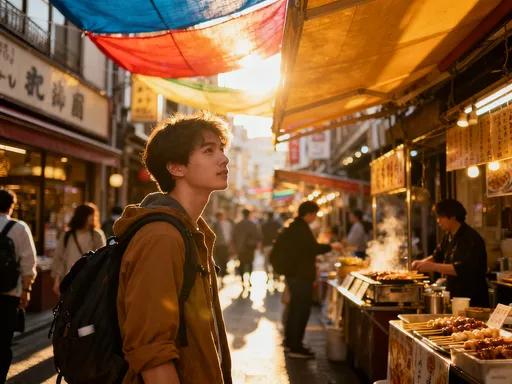
No single place captures the soul of Papeete quite like Le Marché de Papeete, the city’s central marketplace. Open daily but most vibrant in the mornings, this bustling hub is where commerce, culture, and community converge. Stepping inside is an assault on the senses—in the best possible way. The air is thick with the perfume of vanilla beans, fresh coconut, and grilled fish. Rows of vibrant fruits—papayas the color of sunrise, starfruit gleaming like polished glass, and deep purple taro—line wooden stalls under colorful awnings.
The market is divided into sections, each with its own character. The produce wing overflows with island-grown staples: breadfruit, yams, and plantains, all arranged with care. Nearby, the fish market displays the morning’s catch—tuna, mahi-mahi, and parrotfish—laid out on crushed ice, still glistening. Vendors, many of whom have worked these stalls for decades, greet regulars by name and offer advice on the best ways to prepare each cut.
One of the most beloved experiences is sampling *poisson cru*, Tahiti’s national dish. Made from raw tuna marinated in lime juice and coconut milk, it’s often served in a hollowed-out pineapple or coconut shell. Trusted stalls prepare it fresh each morning, and eating it here—surrounded by the chatter of locals, the clink of knives on cutting boards, the occasional burst of Tahitian song—is a meal that nourishes more than the body.
The craft section offers handmade souvenirs that reflect true Polynesian artistry. Black pearls, carefully graded and set in simple silver, catch the light. Woven hats, known as *pae’u*, and tapa cloth dyed with natural pigments tell stories through pattern and texture. Unlike mass-produced trinkets found in tourist shops, these items carry the imprint of their makers. Many artisans are happy to explain their techniques, offering insight into traditions passed down through generations.
Visiting the market mindfully enhances the experience. Arriving early, around 7 or 8 a.m., allows travelers to witness the market at its most authentic—before the midday heat and tourist crowds arrive. Bringing reusable bags not only reduces waste but shows respect for local values of sustainability. Engaging vendors with a simple *ia ora na* (hello) or *maururu* goes a long way. This is not just shopping; it’s participation in a living culture.
Commercial Streets with Character: Walking the Boulevard and Side Lanes
Just beyond the market lies Papeete’s main commercial artery: Boulevard Pomare. Lined with shops, banks, and open-air cafés, this broad street is the city’s economic spine. Yet, it is far from generic. Here, French Polynesian identity shines through in subtle but meaningful ways. Storefronts display bilingual signs in French and Tahitian. Music drifts from radios—sometimes Edith Piaf, other times traditional drumming. The architecture blends colonial-era buildings with modern adaptations, their pastel facades softened by climbing bougainvillea.
Walking is the best way to experience the boulevard. Unlike cities built for speed, Papeete rewards the pedestrian. There is no rush, no need to check a watch. Instead, attention turns to detail: a hand-painted sign advertising fresh coconuts, a grandmother selling plumeria garlands from a wicker basket, a street artist sketching portraits under a canvas canopy. These small moments accumulate into a rich portrait of urban island life.
Equally rewarding are the side lanes that branch off the main drag. These quieter streets reveal hidden gems—a family-run bakery offering coconut-filled pastries, a tailor stitching traditional *pareo* wraps, a small bookstore with volumes on Polynesian mythology. Unlike resort towns designed for convenience, Papeete’s charm lies in its unpredictability. You cannot plan for the moment a local invites you to taste a new fruit or shares a story about the history of a building.
For those seeking authentic souvenirs, the key is discernment. While some shops sell imported goods, others proudly feature local brands. Look for labels indicating “Made in Tahiti” or ask vendors about the origin of their products. Purchasing from local artisans supports the community and ensures that what you take home carries genuine meaning. A hand-carved wooden bowl, a bottle of pure vanilla extract, or a piece of black pearl jewelry—these are not just mementos, but connections to people and place.
Café Culture and Urban Oases: Where to Pause and Reconnect
In a city that values presence over productivity, spaces for rest are not luxuries—they are necessities. Papeete’s café culture thrives in small, unassuming spots where time slows and conversation flows. Whether tucked into a corner of the market or perched along the waterfront, these oases invite travelers to sit, sip, and observe.
One of the most cherished rituals is drinking *café ti’o*, Tahitian coffee. Dark, rich, and often served with a hint of coconut milk, it is best enjoyed slowly. Cafés like those near Place Toata or along the seafront promenade offer plastic chairs and simple tables, but the views are priceless. Watch fishing boats bob in the marina, listen to the distant call of a church bell, feel the breeze carry the scent of the ocean. There is no pressure to order another round or vacate your seat. Lingering is not just allowed—it is expected.
These pauses are not idle moments. They are essential to understanding Papeete. In stillness, details emerge: the way sunlight dances on the water, the rhythm of a vendor’s speech, the laughter of children playing near a fountain. This is where travelers begin to feel, rather than just see, the city. The soul of Papeete is not found in guidebooks or photo ops, but in the quiet spaces between actions.
Some of the best spots are the least advertised. A shaded courtyard behind a clothing shop, a bench overlooking the ferry terminal, a tiny kiosk selling fresh coconut water—these unmarked places often provide the most authentic experiences. There is no Wi-Fi, no menu of international drinks, no souvenir racks. Just simplicity, comfort, and the company of those who live here.
For visitors accustomed to fast-paced itineraries, this kind of stillness may feel unfamiliar, even uncomfortable. But in Papeete, stillness is not emptiness—it is fullness. It is the space where connection happens, where the mind quiets, and where the heart opens to a place and its people.
Local Encounters: How Commerce Opens Doors to Connection
In Papeete, every transaction has the potential to become a relationship. Whether buying fruit from a roadside stand or selecting a pareo at a family shop, the exchange often extends beyond money and goods. A simple “Where are you from?” can lead to a ten-minute conversation. A compliment on a vendor’s basket weaving might result in a spontaneous lesson. These moments are not staged; they are born of genuine openness.
Language plays a small but powerful role. While French and Tahitian are the dominant languages, most vendors in commercial areas understand basic English. Yet, making an effort to use a few words of Tahitian—*ia ora na* (hello), *maita’i* (good), *maururu* (thank you)—is met with warm smiles and often, greater willingness to share. It signals respect, a desire to connect on local terms rather than tourist expectations.
These interactions often lead to unexpected invitations. A fishmonger might recommend a quiet beach where the water is clear and the crowds absent. A baker could point you to a hidden garden behind a church. A shopkeeper may invite you to return the next day to see a new shipment of hand-carved tikis. These are not promotional gestures; they are acts of hospitality, rooted in Polynesian values of generosity and welcome.
The rewards of slow, mindful commerce are profound. You begin to see Papeete not as a destination, but as a community. The city’s pulse becomes your own. You learn its rhythms, its silences, its joys. And in return, you are not just remembered as a customer, but as someone who took the time to see, to listen, to be present.
Practical Slow Travel: Tips for Immersive Urban Exploration in Papeete
Embracing slow travel in Papeete is not only enriching—it is entirely practical. With a few thoughtful choices, visitors can deepen their experience while moving with ease through the city. One of the best ways to explore is by scooter. Lightweight, affordable, and widely available for rent, scooters offer the freedom to navigate narrow streets and pull over at spontaneous discoveries. They are also a favorite among locals, allowing travelers to blend in rather than stand out.
Carrying small bills is another simple but essential tip. Many vendors, especially in the market, prefer cash and may not have change for large notes. Having 1,000 or 5,000 CFP franc bills on hand ensures smooth transactions and shows respect for local customs. Similarly, bringing a reusable bag or tote is both eco-friendly and practical, as plastic bags are increasingly discouraged in French Polynesia.
Timing matters. The market is at its liveliest and most authentic on weekday mornings. Visiting Tuesday through Thursday avoids weekend crowds while ensuring full vendor participation. Midday, when the sun is strongest, is better spent resting or enjoying a café break. Late afternoons offer golden light for strolling and cooler temperatures for exploring side streets.
Accommodation choices also shape the experience. While luxury resorts offer comfort, staying in a guesthouse or boutique hotel within Papeete provides direct access to daily life. Many of these lodgings are run by families who are happy to share local tips, from the best place to buy fresh bread to the schedule of weekly cultural events. Waking up in the city means you can step outside and immediately become part of its rhythm.
To balance urban exploration with cultural depth, pair market visits with nearby landmarks. The Notre-Dame Cathedral, with its coral stone walls and wooden carvings, offers a quiet space for reflection. Place Toata, the city’s main square, often hosts festivals, craft fairs, and live music. The Robert Wan Pearl Museum provides insight into one of Tahiti’s most famous exports, while also celebrating Polynesian art and history.
Ultimately, the most valuable tool for slow travel is intention. Come not to collect experiences, but to receive them. Let Papeete guide you. Say yes to the unexpected. Sit longer than you planned. Smile at strangers. Ask questions. Taste what’s offered. In doing so, you move beyond tourism and into the realm of true connection.
Papeete is not a place to be conquered or checked off a list. It is a place to be felt, lived, and remembered not for its sights, but for its soul. When travelers slow down, they discover that the heart of Tahiti beats strongest not on the distant shores, but in the markets, streets, and smiles of its capital. Here, in the everyday, lies the extraordinary.