You Won’t Believe What I Discovered in Yellowstone
Yellowstone isn’t just about geysers and bears—there’s a deeper story beneath the trails. I went searching for adventure but found something unexpected: living culture, quiet traditions, and connections that time forgot. From Native voices echoing through canyons to ranchers keeping old ways alive, this park is more than a destination. It’s a feeling. And honestly? I wasn’t ready for how much it changed me. The scent of pine after rain, the distant howl of a wolf at dusk, the steam rising from a thermal pool at sunrise—these are the moments most visitors come for. But what I discovered was not only in the landscape, but in the people who have lived with it for generations. This is not just a national park. It is a living story, still being told.
First Impressions: Beyond the Postcard
When I first arrived at Yellowstone National Park, the scene was exactly what I had seen in photographs: crowds gathered at the Old Faithful viewing area, families leaning over railings with cameras raised, children pointing excitedly at the steam rising from the ground. The geyser erupted on schedule, as it has for over a century, sending a column of water and vapor skyward to the predictable applause of onlookers. It was impressive, yes, but also strangely familiar, like watching a reenactment of a moment I’d already lived through on a screen.
Yet, as I moved beyond the main circuits—away from the paved paths and souvenir stands—I began to notice something different. A quietness settled in the air. The trees grew denser, the trails narrower, and the signs of human presence changed. Instead of park service bulletins, I saw small interpretive plaques with names I didn’t recognize: Sheepeater, Tukudika, Apsáalooke. These were not random words, I would later learn, but names of Indigenous peoples whose ancestors walked these same trails for thousands of years before the park was ever established.
One afternoon, near the edge of the Firehole River, I paused to listen to a park ranger speaking to a small group. She mentioned in passing that the land beneath our feet had once been a seasonal gathering place for tribes traveling between high mountain meadows and valley hunting grounds. “They didn’t just live here,” she said. “They belonged to it.” That phrase stayed with me. It wasn’t the language of tourism; it was the language of relationship. And it marked the beginning of a shift in how I saw the park—not as a scenic escape, but as a place layered with memory, meaning, and ongoing presence.
The People Behind the Park
For many visitors, Yellowstone is synonymous with wilderness untouched by human hands. But the truth is far more complex. Long before it became the world’s first national park in 1872, this land was home to at least 27 Native American tribes with deep cultural, spiritual, and subsistence ties to the region. Among them are the Eastern Shoshone, the Bannock, the Crow (Apsáalooke), the Blackfeet, and the Nez Perce—all of whom traveled, hunted, gathered, and prayed in these mountains, valleys, and thermal basins.
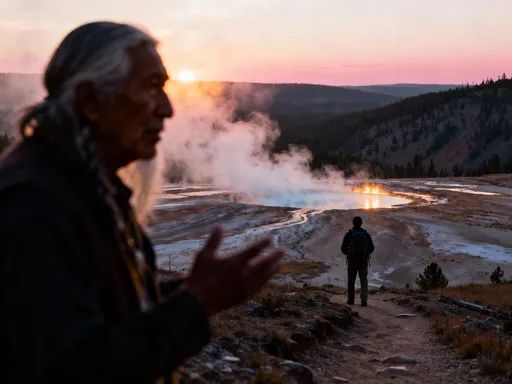
Their connection to the land was not merely practical; it was sacred. Thermal features, often viewed today as geological curiosities, were seen by many tribes as portals to the spiritual world, places of healing, and sources of power. The bubbling mud pots and steaming fumaroles were not just natural phenomena—they were alive with meaning. The Shoshone, for example, have oral histories that speak of the Earth breathing, of ancestors emerging from beneath the ground, and of mountains that speak when listened to with reverence.
Yet for decades, this history was minimized or erased from the official narrative of Yellowstone. The creation of the park, while celebrated as a conservation milestone, came at a cost. Tribal communities were displaced, access restricted, and cultural practices suppressed. Many families were separated from ancestral lands they had stewarded for generations. The myth of “pristine wilderness” often ignored the fact that Indigenous peoples had shaped and sustained this ecosystem through controlled burns, seasonal migrations, and deep ecological knowledge.
Today, the National Park Service has begun to acknowledge this history more fully. At visitor centers in West Yellowstone and Gardiner, exhibits now include tribal artifacts, photographs, and recorded stories from elders. Ranger-led programs increasingly incorporate Indigenous perspectives, and collaborative efforts with tribal nations are helping to restore traditional place names and cultural practices within park boundaries. These changes are not just symbolic—they are a step toward reconciliation and a more honest understanding of what Yellowstone truly is.
Hidden Encounters: Where Culture Comes Alive
The turning point of my journey came on a cool morning in the Lamar Valley, often called “America’s Serengeti” for its abundance of wildlife. I had come hoping to see bison or wolves, but instead, I found something even more profound. Near a pull-off along the road, I noticed a small group gathered around an older man in a worn cowboy hat and a beaded vest. He was speaking quietly, his voice carrying across the grassland.
I hesitated, not wanting to intrude, but he welcomed me with a nod. His name was Thomas Red Elk, a cultural interpreter with Lakota and Crow heritage, and he was sharing a story about the first people and the creation of the buffalo. As he spoke, the wind rustled the sagebrush, and a herd of bison moved slowly in the distance, their breath visible in the cold air. His words were not performed for tourists; they were offered as a gift, a way of keeping memory alive.
Later that week, I visited the Eastern Shoshone Cultural Center near Fort Washakie, just outside the southern boundary of the park. Inside, I met a young woman named Marla, who guided me through an exhibit on traditional plant use. She showed me how bear root was harvested sustainably, how willow bark was used for medicine, and how every part of the animal was honored after a hunt. “We don’t take more than we need,” she said. “And we always give thanks.” Her words resonated deeply. In a world of fast consumption and disposable experiences, this was a different kind of wisdom—one rooted in balance, respect, and reciprocity.
These encounters were not staged attractions. They were real moments of connection, fragile and fleeting, yet powerful in their authenticity. They transformed my understanding of the park. No longer was it just a collection of sights to check off a list. It became a place where culture and nature were inseparable, where stories were carried in the wind, the soil, and the silence between words.
Voices of the Land: Listening to Local Stories
One of the most humbling realizations during my time in Yellowstone was how much I had overlooked simply because I didn’t know how to listen. So many landmarks bear names given by early explorers or surveyors—names like Hayden Valley, Mount Washburn, or Shoshone Lake—yet each of these places also has older names, spoken in languages that predate the American West.
Take, for example, the place known today as Mammoth Hot Springs. To the Shoshone, it is called *Nín̓ wí·ka*, meaning “place of hot water rising.” To the Crow, the same area is linked to stories of the trickster figure Iitskáaksuuaao, who shaped the land with fire and water. These names are not just labels—they are stories, teachings, and maps of understanding. They tell you not just where you are, but how to be in that place.
Unfortunately, many of these names and their meanings remain hidden from the average visitor. Park maps, guidebooks, and signage still prioritize English names, often without context. But change is coming. In recent years, the National Park Service has partnered with tribal historians to reintroduce Indigenous place names in educational materials. At select trailheads and visitor centers, bilingual signs now appear, offering both the official name and its Indigenous counterpart.
More importantly, there is a growing effort to center oral tradition in park programming. Ranger talks now sometimes begin with land acknowledgments. Story circles are held during cultural heritage months. And digital archives are being created to preserve the voices of elders who remember the old ways. These initiatives do more than educate—they invite visitors to see the landscape not as a static backdrop, but as a living, breathing entity shaped by generations of human experience.
When you begin to listen, the park changes. The geysers are no longer just eruptions of water and steam—they are reminders of the Earth’s pulse. The rivers are not just for fishing or rafting—they are ancestors’ pathways. And the silence between bird calls? That, too, has a name, and a story, if you’re willing to learn it.
Ranching Roots and Western Legacy
While much of the cultural narrative around Yellowstone focuses on its Indigenous past, another layer of human history thrives just beyond the park’s borders: the legacy of the American rancher. In towns like Cody, Montana, and Jackson, Wyoming, the spirit of the Old West endures in working cattle ranches, family-run dude operations, and community rodeos that draw both locals and visitors.
I spent a few days at a guest ranch near Gardiner, where I met Sarah and Tom, a couple who have operated the property for over thirty years. Their family has lived in the region for five generations, and their connection to the land is evident in every detail—the way Tom knows which meadow the elk will cross in early November, or how Sarah preserves berries each summer using her grandmother’s recipe.
Life here is not romanticized. It is demanding, shaped by long winters, unpredictable weather, and the constant balance between livelihood and conservation. “We don’t own this land,” Tom told me one evening as we sat by the fire. “We’re just its keepers for a while.” That sentiment, so similar to the Indigenous worldview I had encountered, struck me. Despite different histories and traditions, both communities share a deep respect for the land and a commitment to stewardship.
Still, tensions exist. As tourism grows and land values rise, many family ranches face pressure to sell. Conservation easements help some, but not all can afford to stay. Meanwhile, debates continue over grazing rights, wildlife migration corridors, and the impact of development. These are not simple issues, but they are part of the living culture of the region—a culture that is evolving, adapting, and striving to preserve what matters.
Visiting a working ranch offers a rare glimpse into this world. Guests can help with morning chores, ride horses through open meadows, or share meals made from homegrown food. These experiences do more than entertain—they build understanding. They remind us that culture is not frozen in time, but lived every day in the choices people make to honor their heritage while facing the future.
Traveling with Respect: How to Engage Meaningfully
One of the most important lessons I took from my journey is that cultural discovery requires more than curiosity—it requires respect. To truly engage with the living cultures of Yellowstone, travelers must move beyond passive observation and embrace a mindset of humility and reciprocity.
A good starting point is to visit tribal cultural centers and museums located near the park. The Eastern Shoshone Cultural Center, the Buffalo Bill Center of the West in Cody, and the Little Bighorn Battlefield National Monument all offer thoughtful, accurate portrayals of Indigenous history and contemporary life. These institutions are often run by tribal members and provide a platform for authentic storytelling.
Supporting Native-owned businesses is another meaningful way to contribute. Whether it’s purchasing handcrafted beadwork, attending a traditional dance performance, or dining at a Native-run café, these actions help sustain cultural economies and honor the work of artisans and entrepreneurs. Many of these businesses operate seasonally, so planning ahead is essential.
For those interested in deeper engagement, public events such as powwows—when open to visitors—offer a vibrant introduction to music, dance, and community. However, it’s crucial to remember that not all cultural practices are meant for outsiders. Some ceremonies are sacred and private. Photography should always be approached with caution; asking permission is not just polite—it is necessary.
Equally important is the practice of mindful tourism. This means staying on designated trails, refraining from touching artifacts or sacred objects, and respecting closure signs, especially in areas of cultural significance. It also means listening more than speaking, learning before sharing opinions, and recognizing that some stories are not ours to retell.
When we travel with intention, we do more than see a place—we begin to understand it. And in doing so, we honor not just the land, but the people who have守护 it for generations.
Why This Changes Everything
Leaving Yellowstone, I found myself reflecting on what true exploration really means. For so long, I had thought of travel as a way to collect experiences—iconic views, perfect photos, bucket-list moments. But this journey taught me that the most lasting memories are not the ones we capture with a lens, but the ones we carry in our hearts.
Discovering the cultural depth of Yellowstone didn’t diminish its natural beauty—it deepened it. The geysers felt more powerful when I understood their spiritual significance. The bison herds moved with greater majesty when I knew the stories of their survival. The silence of the forest became richer when I realized it held voices that had been speaking for millennia.
This is the heart of meaningful travel: recognizing that people are not separate from nature, but part of its fabric. The rancher guiding his cattle across a frost-covered field, the elder sharing a story by firelight, the child learning a traditional song—these are not distractions from the wilderness. They are expressions of it.
As travelers, we have a choice. We can rush through destinations, chasing highlights and hashtags, or we can slow down, listen closely, and allow ourselves to be changed. We can treat parks like museums—static and silent—or we can see them as living landscapes, shaped by time, tradition, and resilience.
Yellowstone taught me that belonging is not something we claim. It is something we earn—through respect, through listening, through the willingness to learn. And when we do, we don’t just visit a place. We become part of its story.
So the next time you plan a trip, ask yourself: Am I ready to go deeper? Not just into the wild, but into the heart of what it means to be human within it? Because when you do, you might find, as I did, that the most unexpected discoveries are not out there in the landscape—but within yourself.